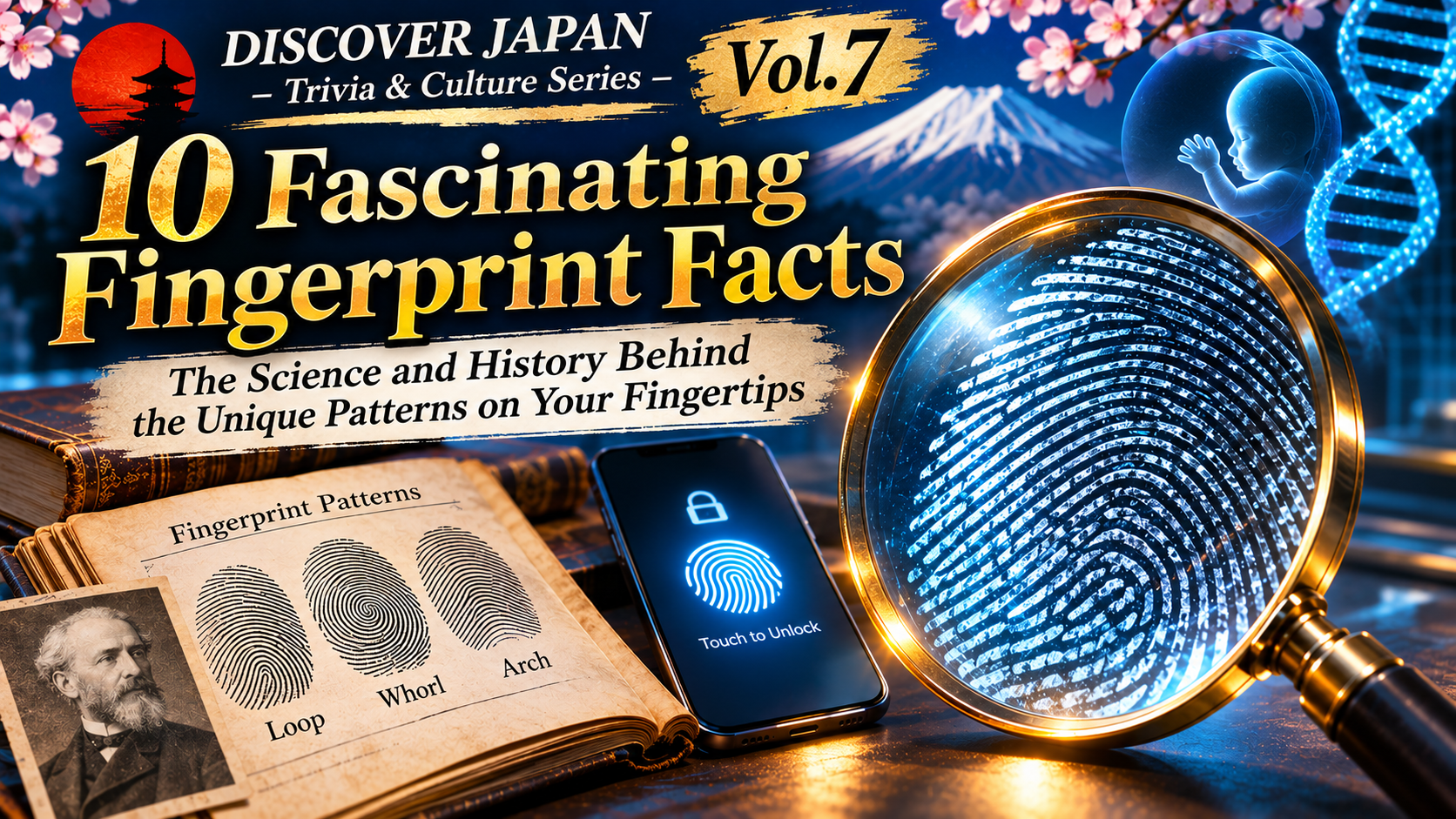
10 Fascinating Fingerprint Facts: The Science and History Hidden in Your Fingertips
Discover Japan – Trivia & Culture Series | Vol.7
Discover the Japan Hidden in Everyday Life.
Hello, I’m R2-TM.
You touch your smartphone. The screen unlocks. It happens so quickly that you probably give little thought to the tiny lines covering your fingertip.
But those lines have an extraordinary story.
They began developing before you were born. They help shape the way your fingers interact with the world. And long before smartphones existed, they attracted the attention of researchers searching for a reliable way to distinguish one person from another.
Some of that history even leads to nineteenth-century Japan, where a British physician made observations that helped shape the future of fingerprint identification.
In this installment of Discover Japan – Trivia & Culture Series, we’ll explore ten fascinating fingerprint facts, from the remarkable biology of identical twins to modern biometric security and the surprising origins of forensic identification.
The next time you unlock your phone, you may never look at your fingertips quite the same way again.
- 1. Why Are Fingerprints Different? A Pattern of Tiny Details
- 2. Even Identical Twins Have Different Fingerprints
- 3. Fingerprints Begin Forming Before Birth
- 4. The Three Main Fingerprint Patterns: Loops, Whorls, and Arches
- 5. Fingerprints May Help Us Experience the Sense of Touch
- 6. Do Fingerprints Change as You Get Older?
- 7. How Does Smartphone Fingerprint Recognition Work?
- 8. How Reliable Is Fingerprint Evidence in Criminal Investigations?
- 9. The Surprising History of Fingerprints: From Japan to Modern Forensics
- 10. Fingerprints Are Not Just on Your Fingers
- Five More Fingerprint Facts Worth Knowing
- Extra Fact 1: Fingerprints Cannot Reliably Reveal Your Personality
- Extra Fact 2: Touching Something Doesn’t Guarantee a Usable Fingerprint
- Extra Fact 3: Some People Are Born Without Typical Fingerprint Ridges
- Extra Fact 4: Fingerprint Patterns Are Studied in Medicine and Genetics
- Extra Fact 5: You Can’t Reset a Fingerprint Like a Password
- What Fingerprints Teach Us About Biology and Technology
- Conclusion: A Small Pattern With a Remarkable Story
- Continue Exploring Discover Japan
- References and Further Reading
- Next Episode
1. Why Are Fingerprints Different? A Pattern of Tiny Details
Take a close look at your thumb.
You’ll notice delicate raised lines running across the skin. Some curve gently. Others split into branches or disappear into the surrounding pattern.
These raised lines are called friction ridges.
When fingerprint specialists compare prints, they don’t simply look for a large spiral or loop. They also examine smaller details, including where individual ridges end and where one ridge divides into two.
These details are often called minutiae.
Imagine two people whose fingerprints both contain a circular pattern. At first glance, they may appear almost identical. But when examined more closely, the positions of the ridge endings, branches, and surrounding features may be quite different.
Are fingerprints truly unique?
You may have heard that no two people on Earth have exactly the same fingerprints.
Fingerprint patterns show enormous individual variation, and they have proved extremely useful for identification. However, nobody has compared every fingerprint belonging to every person who has ever lived.
It would therefore be misleading to claim that universal uniqueness has been mathematically demonstrated.
The distinction matters because forensic identification is not based on a magical property of fingerprints. It depends on the quality of the available impressions, the features that can be compared, and the reliability of the examination process.
Those tiny lines are remarkably informative. But science works best when we understand both their value and their limitations.
2. Even Identical Twins Have Different Fingerprints
Identical twins can look so alike that even close friends sometimes struggle to tell them apart.
Since they develop from the same fertilized egg and generally share nearly identical genetic information, you might expect their fingerprints to match perfectly.
They don’t.
Identical twins may share broad fingerprint characteristics, but the finer arrangement of their ridges differs.
The explanation lies in the way fingerprints develop.
Genes influence the growth and shape of the hands. Yet fingerprints are not produced from a rigid genetic blueprint that specifies the exact position of every ridge.
Local developmental conditions also matter. Small differences in the shape of a developing fingertip, the timing of tissue growth, and interactions between developing skin cells can influence the final pattern.
Research published in the journal Cell in 2023 revealed an important part of this process.
The researchers found that fingerprint ridges develop through interacting molecular signals, with pattern-forming activity spreading from different locations on the developing fingertip.
As these developing patterns meet, they help produce the familiar loops, whorls, and arches.
Think of two artists using the same materials and following similar instructions. Their paintings might resemble one another, but the smallest brushstrokes would not necessarily be identical.
Fingerprints are not works of art in the literal sense, of course. They emerge from biological development.
Yet the comparison captures something important: similar starting conditions do not guarantee identical outcomes.
Read the 2023 fingerprint development study in Cell.
3. Fingerprints Begin Forming Before Birth
Picture a newborn baby wrapping a tiny hand around an adult’s finger.
Those delicate fingertips already carry patterns that began forming months earlier.
Fingerprints do not appear because babies start touching objects after birth.
Their development begins during fetal growth.
As the hands and feet take shape, the developing skin undergoes a series of changes. Temporary swellings on the fingertips, often called volar pads, are associated with the conditions in which the future ridge patterns form.
During the first and second trimesters, the skin begins developing the ridges that will eventually become recognizable fingerprints.
By the time a baby is born, the underlying pattern has largely been established.
What happens as a child grows?
A baby’s fingers are much smaller than an adult’s. Yet the basic arrangement of the ridges generally remains stable as the hands grow.
The pattern becomes larger as the finger develops, rather than being completely redesigned every few years.
This stability is one reason fingerprints can be useful for identification across long periods of a person’s life.
Consider the timeline for a moment.
Before you received your first name, attended school, or learned to hold a pencil, your fingertips had already begun developing patterns that would accompany you into adulthood.
It’s a small piece of personal history written into your skin.
4. The Three Main Fingerprint Patterns: Loops, Whorls, and Arches
Here’s an observation exercise that requires nothing more than your own hands.
Find a well-lit place and look carefully at the center of your thumbprint.
Does the pattern curl around? Does it loop back toward one side? Or does it flow across the fingertip in a gentle rise?
Fingerprint patterns are commonly grouped into three broad categories.
Loops
A loop forms when the ridges enter from one side, curve around, and return toward that same side.
Loop patterns are commonly observed in human fingerprints. Their characteristic curved flow makes them relatively easy to recognize.
Whorls
Whorls feature circular, spiral-like, or related rounded formations near the center of the fingerprint.
Some look like tightly arranged rings, while others have more complicated shapes.
Arches
In an arch, the ridges generally enter from one side and continue toward the opposite side, rising in the middle.
Some arches are smooth and gentle. Others have a sharper central rise.
These are broad categories, not a complete description of every possible fingerprint.
Professional classification systems can distinguish additional variations, and some patterns are difficult to place into a simple category.
Now compare the fingers on your other hand.
You may notice that your thumb has one type of pattern while your index finger has another. Even neighboring fingers don’t have to follow the same design.
One practical note: avoid posting highly detailed photographs of your fingerprints online. Biometric information deserves the same thoughtful handling as other sensitive personal information.
5. Fingerprints May Help Us Experience the Sense of Touch
Try closing your eyes and running a fingertip across a cotton towel.
Now do the same with a sheet of paper.
The difference is immediate.
Your fingertips can detect remarkably subtle changes in texture, pressure, and vibration.
It’s tempting to explain fingerprints as nothing more than built-in grips that stop objects from slipping. But their relationship with friction is more complicated.
Fingerprints do not necessarily increase friction under every condition. The outcome depends on factors such as the material being touched, moisture, and the mechanics of contact.
Researchers are also interested in how fingerprint ridges affect the signals associated with touch.
When your finger moves across a textured surface, the interaction can produce tiny mechanical vibrations. Sensory receptors in the skin respond to mechanical changes and help the nervous system interpret the surface.
Fingerprint ridges influence how forces and vibrations travel through the fingertip.
What artificial fingerprints have taught researchers
A study published in Advanced Science in 2024 used flexible artificial sensors to investigate the effects of different fingerprint patterns on tactile signals.
By recreating ridge patterns and testing how they responded to textures, the researchers found that fingerprint geometry affected the transmission of vibration.
This doesn’t mean scientists have proved that one person’s fingerprints automatically provide better touch sensitivity than another person’s.
The experimental findings instead offer clues about the relationship between ridge structure and mechanical signals.
There’s a striking connection here.
The same small structures that are useful for identifying a person may also participate in the complex mechanics of everyday touch.
Explore the 2024 tactile sensor study.
6. Do Fingerprints Change as You Get Older?
Sometimes a fingerprint scanner refuses to recognize a finger that worked perfectly yesterday.
You press harder. Try a different angle. Wipe your fingertip. Eventually, the device unlocks.
Did your fingerprint change overnight?
Probably not.
The basic ridge configuration is generally stable over time. However, the condition of the skin can change considerably.
Dryness, moisture, swelling, minor injuries, and surface wear can all affect how clearly a fingerprint can be recorded.
This distinction is particularly important for people who regularly work with their hands.
Repeated contact with tools, rough surfaces, cleaning products, or other materials may temporarily affect the fingertip surface.
Minor injuries often heal without permanently changing the underlying ridge arrangement.
Deeper injuries are different.
If an injury damages the structures responsible for maintaining the skin’s pattern, scarring can permanently alter part of the fingerprint.
Age-related skin changes can also affect the clarity of an impression.
So when people say fingerprints last a lifetime, it’s better to understand that as a statement about their general stability—not a promise that every scan will always look exactly the same.
7. How Does Smartphone Fingerprint Recognition Work?
A fingerprint unlock feels almost effortless.
But beneath that simple gesture lies a sophisticated process of measurement and comparison.
When you register a fingerprint, a compatible device captures information about the ridge pattern and creates a biometric representation that can be used during later authentication.
When you attempt to unlock the device, the newly captured information is compared with the registered data.
Not every fingerprint sensor works in the same way.
Optical fingerprint sensors
Optical systems use light and imaging technology to capture the fingerprint pattern.
They are conceptually similar to taking a specialized image of the fingertip, although the exact design varies between devices.
Capacitive fingerprint sensors
Capacitive sensors detect differences in electrical properties associated with the ridges and valleys of the finger.
Instead of relying on an ordinary photograph, they use electrical measurements to reconstruct useful fingerprint features.
Ultrasonic fingerprint sensors
Ultrasonic systems use high-frequency sound waves and their reflections to measure features of the fingertip.
These systems can gather information using a different physical mechanism from optical or capacitive sensors.
Why doesn’t the scanner require a perfect match?
Your finger rarely lands on a sensor in exactly the same position twice.
Its angle, pressure, and contact area can vary. Fingerprint recognition systems therefore evaluate similarity rather than requiring two identical images.
This creates an important balance between usability and security.
A system that is too strict may reject its legitimate owner. A system that is too permissive may be more vulnerable to false acceptance.
Biometric authentication is useful, but it isn’t infallible.
And unlike a password, a fingerprint cannot simply be replaced when its biometric information is compromised.
That’s why device passcodes, operating-system updates, and responsible handling of biometric data remain important.
8. How Reliable Is Fingerprint Evidence in Criminal Investigations?
You’ve probably seen the scene in a crime drama.
An investigator discovers a fingerprint on a glass. A computer scans it. Seconds later, a name appears on the screen.
Case solved.
Real forensic work is rarely so tidy.
When someone touches a surface, material from the skin may leave an impression. These are often called latent fingerprints when they are not readily visible without special examination or development techniques.
But a contact does not guarantee a clear, usable print.
A surface may be textured or absorbent. The impression may be partial, smeared, distorted, or mixed with other impressions.
Sometimes there simply isn’t enough reliable detail to reach a conclusion.
A fingerprint cannot tell the entire story
Even when a fingerprint can be associated with a person, it does not automatically establish when the surface was touched or why.
A fingerprint on an object may be relevant evidence, but interpreting its significance requires consideration of the broader circumstances.
Fingerprint comparisons can involve trained examiners, specialized imaging techniques, and computerized search systems.
Computer systems can help locate potentially relevant records. The resulting comparisons still require appropriate evaluation and quality controls.
Research has documented both the usefulness of fingerprint examination and the possibility of examiner errors.
The US National Institute of Standards and Technology (NIST) has contributed to research and standards concerning the reliability of forensic fingerprint work.
The essential lesson is simple: fingerprints can provide powerful evidence, but a responsible examination should never be described as automatically or universally 100 percent accurate.
That distinction may make crime dramas less convenient. It also makes real investigations more scientifically responsible.
Learn about the latent print examination process.
9. The Surprising History of Fingerprints: From Japan to Modern Forensics
In the late nineteenth century, a British physician working in Japan became interested in marks left by human fingertips.
His name was Henry Faulds.
That small historical connection is one of the most compelling parts of the fingerprint story.
Long before electronic scanners appeared, people had already used finger and hand impressions on documents and other materials. However, these earlier practices should not automatically be confused with modern scientific fingerprint identification.
The development of systematic fingerprint identification involved contributions from several individuals over many decades.
William Herschel: Fingerprints in administrative records
William James Herschel, a British administrator working in India, used hand and finger impressions in administrative practices during the nineteenth century.
He became interested in their potential usefulness for establishing identity and connecting individuals with records.
His observations were part of the emerging recognition that the ridge patterns of human skin could serve as persistent identifying features.
Henry Faulds: The important Japanese connection
Faulds worked as a physician in Japan during the Meiji era, a period of rapid change and modernization.
His interest in fingerprints was influenced in part by marks found on pottery.
In 1880, he published a letter in the scientific journal Nature titled On the Skin-Furrows of the Hand.
The letter discussed the potential use of fingerprints for identifying individuals, including in criminal investigations.
Its author affiliation identified him with Tsukiji Hospital in Tokyo, which was commonly written as Tokio in English at the time.
For overseas readers, this is an unexpected detail.
One of the influential early published discussions of fingerprint identification emerged from the observations of a British doctor living and working in Japan.
The story connects Meiji-era Japan with the international history of forensic science.
Read Henry Faulds’s original 1880 letter in Nature.
Francis Galton: Studying fingerprint patterns systematically
Francis Galton helped develop the systematic study of fingerprints, including their patterns and variation.
His research contributed to the growing scientific foundation for using fingerprints in identification.
Researchers increasingly recognized that the large pattern categories were only part of the story. Detailed ridge features also mattered.
Edward Henry and the development of classification systems
Edward Henry is associated with the development and adoption of fingerprint classification methods that made large collections of records more practical to organize and search.
Such systems became important to police and administrative organizations at a time when digital databases did not exist.
Instead of searching computer images, officials had to organize physical records in ways that allowed possible matches to be located.
Fingerprint identification was therefore not the invention of one person.
It emerged through administrative practice, medical observation, scientific research, classification work, and institutional adoption.
From fingerprints on pottery in Japan to modern electronic identification, the tools have changed enormously.
The underlying question has remained familiar: how can we reliably distinguish one individual from another?
10. Fingerprints Are Not Just on Your Fingers
Spread your hands and look at your palms.
Notice the fine lines covering the skin—not just the large creases, but the much smaller ridge patterns between them.
Similar friction-ridge skin appears on the soles of your feet and the undersides of your toes.
These surfaces belong to the same broader system of skin structures commonly described as dermatoglyphics.
Palm impressions and impressions from bare feet can sometimes provide useful information in identification work.
However, a bare footprint and a shoeprint are not the same kind of evidence.
A shoeprint may reveal information about the pattern, size, and wear of a shoe’s sole. A bare footprint can contain anatomical and friction-ridge details from the foot itself.
We rarely examine the fine patterns on our feet with the same curiosity that we give our fingertips.
But the underlying biology is closely related.
Our hands and feet carry a much wider landscape of intricate ridge patterns than the small patch of skin used to unlock a smartphone.
Five More Fingerprint Facts Worth Knowing
Extra Fact 1: Fingerprints Cannot Reliably Reveal Your Personality
You may encounter claims that people with whorls are natural leaders or that certain fingerprint patterns indicate artistic talent.
Such ideas can sound entertaining, especially when presented in colorful personality charts.
But there is no established scientific basis for reliably predicting someone’s personality or future abilities from fingerprint patterns alone.
Enjoy the curiosity if you like. Just don’t mistake it for validated psychological testing.
Extra Fact 2: Touching Something Doesn’t Guarantee a Usable Fingerprint
Crime stories sometimes suggest that every touch leaves behind a perfect fingerprint.
Real life is messier.
Glass, fabric, paper, and metal interact differently with materials transferred from skin.
Moisture, contact pressure, surface contamination, and movement can all affect the resulting impression.
Some contacts leave useful traces. Others leave little or nothing that can be interpreted reliably.
Extra Fact 3: Some People Are Born Without Typical Fingerprint Ridges
Most people have well-developed friction-ridge patterns on their fingers.
There are rare exceptions.
One condition, known as adermatoglyphia, involves the absence of normal ridge patterns on the fingertips and other areas of friction-ridge skin.
The condition is rare, and its effects can vary.
It has sometimes attracted attention because fingerprint-based identity checks can become difficult for affected individuals.
The US National Library of Medicine provides information about this condition through MedlinePlus Genetics.
Extra Fact 4: Fingerprint Patterns Are Studied in Medicine and Genetics
Friction-ridge development is related to processes that take place during fetal growth.
That makes dermatoglyphic patterns interesting to researchers investigating developmental biology, genetics, and certain medical conditions.
However, research interest does not mean that a fingerprint can provide an accurate medical diagnosis.
A pattern on your fingertip is not a substitute for clinical examination, genetic testing, or professional medical advice.
Extra Fact 5: You Can’t Reset a Fingerprint Like a Password
Imagine a password appearing in a data breach.
You can usually change it, enable stronger authentication, and reduce the risk of future misuse.
Fingerprints present a different challenge.
They are biological characteristics, not secret strings you can replace whenever you want.
This is one reason biometric security systems must be carefully designed.
Protection of stored biometric information, device security, and alternative authentication methods all matter.
Convenience is valuable. But the fact that your fingerprint is always with you doesn’t make it an ideal replacement for every other security measure.
What Fingerprints Teach Us About Biology and Technology
There is something worth remembering about this entire story.
Fingerprints did not develop so that humans could unlock phones or solve crimes.
They are biological structures that arise during the development of our skin.
Over time, people noticed their stability and variation, studied their formation, and developed technologies that could make use of them.
A natural feature became the foundation of administrative systems, forensic methods, and modern biometric authentication.
And research continues.
Scientists are still investigating the mechanics of touch, the development of skin patterns, and the performance and limitations of identification technologies.
That makes fingerprints a wonderful example of how discoveries in basic biology can eventually influence everyday life.
Conclusion: A Small Pattern With a Remarkable Story
Fingerprints are easy to overlook.
They are present when we reach for a coffee cup, turn a page, hold a child’s hand, or unlock a smartphone.
Yet those tiny patterns began developing before birth, vary even between identical twins, and have been studied for more than a century as a means of identifying individuals.
They also have limits.
Fingerprint scanners can fail. Forensic comparisons require care. And scientific research continues to reveal new details about the role of friction ridges in human touch.
Perhaps the most surprising lesson is that such a familiar part of the body can connect so many different subjects: embryology, neuroscience, technology, criminal investigation, and history.
It even connects to Japan through the work of Henry Faulds in the nineteenth century.
Next time you unlock your phone, look at your thumb for a moment.
Those small lines carry a story that began before you were born—and one that science is still exploring.
Continue Exploring Discover Japan
Curious about the hidden stories behind familiar things?
In the previous installment of this series, we explored the origins of names such as UNIQLO, Calbee, Nitori, Google, and Rakuten.
Read Vol.6: 5 Surprising Company Name Origins in Japan.
For more stories about Japanese culture, everyday discoveries, and practical technology, visit the R2-TM Blog.
If you’re interested in practical accessories and everyday lifestyle products available in Japan, you can also explore my Rakuten ROOM collection. Product availability, compatibility, and prices should be checked before purchasing.
References and Further Reading
- Glover et al. (2023), The Developmental Basis of Fingerprint Pattern Formation and Variation — Cell.
- Henry Faulds (1880), On the Skin-Furrows of the Hand — Nature.
- W. J. Herschel (1880), Skin Furrows of the Hand — Nature.
- Biometric-Tuned E-Skin Sensor With Real Fingerprints Provides Insights on Tactile Perception — Advanced Science, 2024.
- National Institute of Standards and Technology — Latent Print Examination Process.
- MedlinePlus Genetics — Adermatoglyphia.
Next Episode
Discover Japan – Trivia & Culture Series | Vol.8
Our next installment will explore another collection of surprising stories hidden in everyday life.
Follow the series to discover how ordinary objects, familiar customs, and small details can reveal extraordinary histories.
Editorial Disclaimer: This article is based on scientific studies, historical publications, and publicly available information reviewed at the time of writing. Scientific knowledge and interpretations may change as further research becomes available. Although care has been taken to present information accurately, completeness and absolute accuracy cannot be guaranteed. The article is intended for general educational purposes and does not constitute medical diagnosis, legal advice, or professional forensic assessment. Readers should consult qualified professionals and original sources when making important decisions.
Affiliate Disclosure: This article may contain promotional or affiliate links. If you make a qualifying purchase through such links, the website may receive compensation at no additional cost to you.

コメント