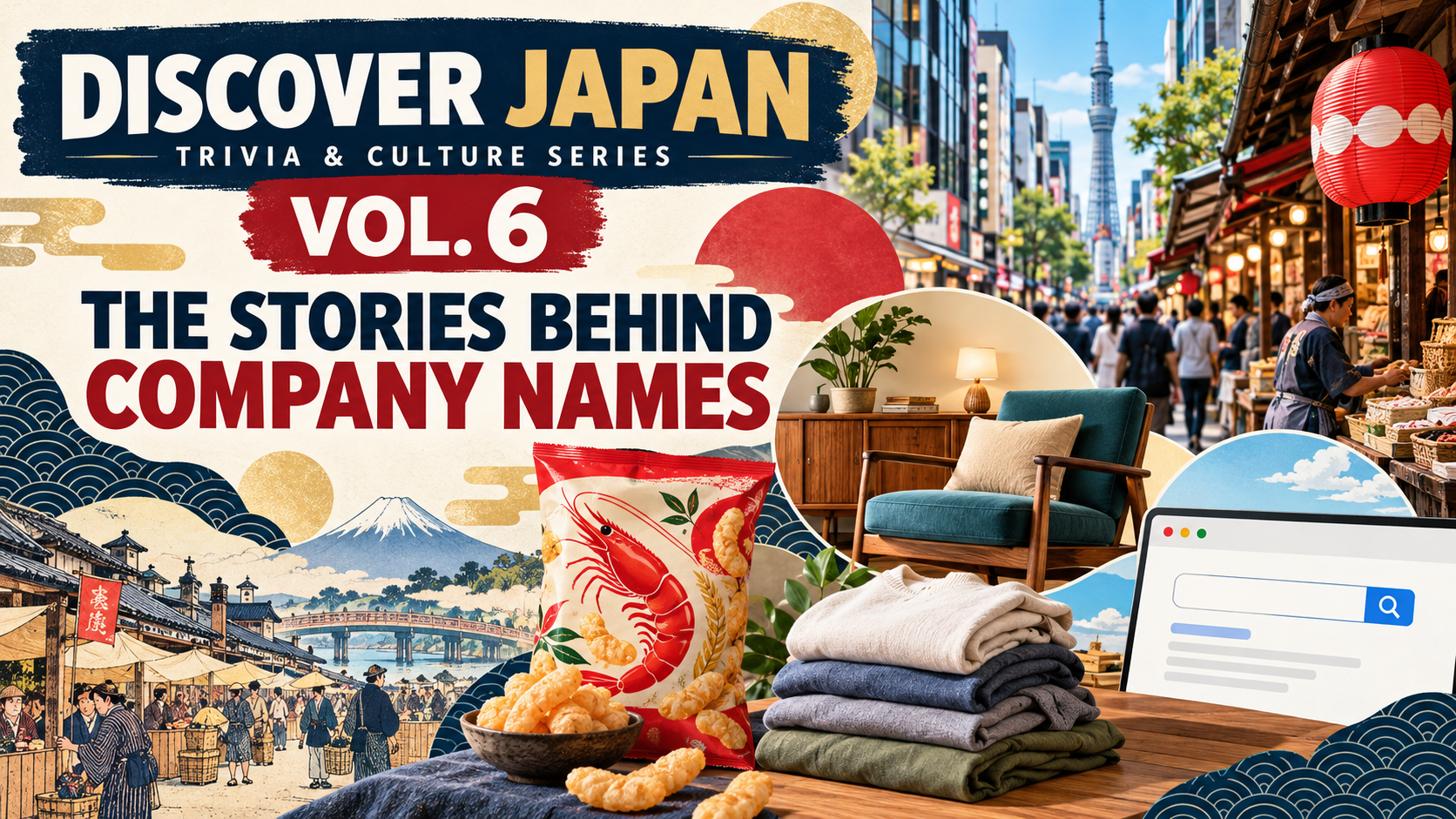
Why Is It Called UNIQLO? 5 Familiar Company Names With Surprising Stories
Hello, I’m R2-TM.
Calbee, Nitori, UNIQLO, Google, and Rakuten. These names appear almost everywhere in everyday Japanese life—on supermarket shelves, beside train stations, inside shopping malls, and across smartphone screens.
But what do the names actually mean?
One began with two nutrients. Another is the founder’s family name. One reaches back to an open-market policy associated with sixteenth-century Japan.
In this installment of the Discover Japan – Trivia & Culture Series, we will explore five familiar company and brand names—and the unexpected stories hidden behind them.
This is not simply a list of corporate facts. Each name offers a small window into Japanese language, regional history, business culture, and the way foreign ideas have been adapted in Japan.
- 1. Calbee: A Name Made From Two Nutrients
- 2. Nitori: The Brand Name Was a Family Name
- 3. UNIQLO: The “Warehouse” Hidden Inside the Name
- 4. Google: A Number With 100 Zeros
- 5. Rakuten: A Modern Company Name With Roots in Japanese History
- Extra Trivia: Two Global Brands Share a Hiroshima Connection
- What These Five Names Have in Common
- Next Episode|Why Is a Green Traffic Light Called “Blue” in Japan?
- Conclusion|A Name Can Be a Small Piece of Cultural History
1. Calbee: A Name Made From Two Nutrients
Walk into a Japanese supermarket or convenience store and you are likely to find Calbee products almost immediately.
The company is best known for potato chips and snacks such as Kappa Ebisen, a light, crunchy shrimp-flavored snack that has been popular in Japan for decades.
“Calbee” sounds like an imported European or American name. In fact, it was created in Japan by combining parts of two English nutrient names:
- “Cal” from calcium
- “Bee” from vitamin B1
Calbee’s predecessor was established in Hiroshima in 1949. When the company adopted the Calbee name in 1955, it wanted the name to represent its ambition to make food that would contribute to people’s health.
Today, few shoppers stop to think about calcium or vitamin B1 when opening a bag of potato chips. Yet the nutritional ideals of the company’s early years remain embedded in the name.
You can confirm the company’s account on the official Calbee history page.
Why is a shrimp snack called “Kappa”?
For international readers, one part of the name Kappa Ebisen may require an explanation.
A kappa is a water-dwelling creature from Japanese folklore. It is often depicted with a turtle-like shell, a beak, and a small dish of water on top of its head.
But Kappa Ebisen is not named after a mythical creature because kappas supposedly enjoy shrimp.
The “Kappa” part was inherited from an earlier Calbee product called Kappa Arare. That snack used a kappa character illustrated by Japanese manga artist Kon Shimizu. When Kappa Ebisen appeared in 1964, the established “Kappa” name remained.
In other words, the shrimp and the kappa were originally separate parts of the product’s story.
There is another local connection. Calbee was founded in Hiroshima, and its founder, Takashi Matsuo, reportedly drew inspiration from the small shrimp found in Japan’s Seto Inland Sea.
To a Japanese shopper, Kappa Ebisen may look like an ordinary nostalgic snack. Behind the package, however, are traces of Japanese folklore, postwar food development, and Hiroshima’s regional food culture.
2. Nitori: The Brand Name Was a Family Name
Nitori is one of Japan’s best-known home-furnishing retailers. Its stores sell furniture, curtains, bedding, kitchenware, storage products, and household appliances.
For many Japanese customers, Nitori is a practical place where much of a room can be furnished at a relatively accessible price.
The origin of the name is surprisingly straightforward.
The company’s founder is Akio Nitori. His family name is written in Japanese as 似鳥 and pronounced Nitori.
Because the retail brand is normally displayed in katakana as ニトリ, many people may never realize that it began as a person’s surname.
This is one of those details that can be easy to miss if you do not read Japanese. Katakana is frequently used for foreign words, modern product names, and brand identities. Writing the name in katakana gives it a simple, contemporary appearance—even though its origin is a traditional Japanese family name.
From a small Sapporo furniture store to a national brand
Nitori began in 1967 as the Nitori Furniture Store in Sapporo, the largest city on Japan’s northern island of Hokkaido.
A major turning point came after Akio Nitori visited the United States in 1972.
He was impressed by American furniture retailers that offered coordinated interiors rather than selling every item in isolation. Furniture, carpets, curtains, and bedding could be selected by color and style to create a complete room.
He also saw products offered at prices far below those common in Japan at the time.
That experience helped shape Nitori’s later approach: giving ordinary households access to coordinated home furnishings at manageable prices.
The company’s official English-language message still describes the founder’s desire to bring the comfort he encountered in American homes to Japanese daily life. You can read it on the Nitori Holdings website.
This is a recurring pattern in modern Japanese culture. An idea arrives from overseas, but it is reorganized and adapted to Japanese homes, budgets, and shopping habits until it becomes something locally distinctive.
3. UNIQLO: The “Warehouse” Hidden Inside the Name
UNIQLO is now an international clothing brand, so many overseas readers already recognize its red square sign.
Its name, however, began as an abbreviation of a much longer English phrase:
UNIQUE CLOTHING WAREHOUSE
The original concept was a store where shoppers could freely browse distinctive, good-quality casual clothing in an informal warehouse-like environment.
Over time, “Unique Clothing Warehouse” was shortened into the much more compact brand name UNIQLO.
The company confirms this meaning in its official Japanese customer guide.
The first UNIQLO opened in Hiroshima at 6 a.m.
The first UNIQLO store opened in Hiroshima on June 2, 1984.
Its opening time was unusually early: 6:00 in the morning.
The idea was to allow customers to visit before work or school. Early visitors were even given bread and milk for breakfast.
The store was designed to feel more like a record shop or bookstore than a traditional clothing boutique. Customers could enter casually, look around, and choose items without the pressure of constant assistance from sales staff.
That relaxed approach may sound normal now, but it helped distinguish the store at the time.
Fast Retailing’s official history confirms both the Hiroshima opening and its unusual early-morning launch.
What began as a casual-wear warehouse in one Japanese city eventually grew into a global brand associated with simple design, functional fabrics, and everyday clothing.
The original name was long. The shortened version was quick to say, visually distinctive, and easier to carry beyond Japan.
4. Google: A Number With 100 Zeros
Google is not a Japanese company, of course. It appears in this article because it has become just as familiar in Japan as the domestic brands around it.
Japanese people use Google for work, school, shopping, travel, restaurant searches, and countless other parts of daily life. The company name has become so familiar that it is easy to forget how unusual it sounds.
Google’s name is based on the mathematical term googol.
A googol is the number 1 followed by 100 zeros.
The enormous number reflected the founders’ ambition to organize a seemingly endless amount of information and make it accessible to people around the world.
Before Google, there was Backrub
Larry Page and Sergey Brin’s early search engine was not originally called Google.
Its first name was Backrub.
The name referred to the system’s analysis of “backlinks”—links from other websites—to help determine the importance of a page.
It made technical sense, but it would have created a very different global brand.
Imagine telling someone, “I’ll Backrub that later.”
The change to Google produced a shorter and more memorable name while connecting the service to the vast amount of information it aimed to organize.
Google’s own company history explains the transition from Backrub to Google on its official story page.
5. Rakuten: A Modern Company Name With Roots in Japanese History
Rakuten is closely woven into modern life in Japan.
The name appears on an online marketplace, credit cards, banking services, travel bookings, mobile communications, and professional sports.
For Japanese readers, the name is written 楽天.
The character 楽 can convey ideas such as enjoyment, comfort, or ease, while 天 means heaven or sky. As a word, rakuten can suggest optimism or a positive outlook.
But the company name also carries a historical reference.
From Rakuichi-Rakuza to an online marketplace
Rakuten says its name was inspired by Rakuichi-Rakuza, a series of free-market policies associated particularly with the sixteenth-century warlord Oda Nobunaga.
These policies aimed to reduce restrictions imposed by established merchant guilds and encourage more open commercial activity.
For an overseas reader, the connection may seem unexpected: a late-twentieth-century internet business looking back to the markets of Japan’s samurai era.
Yet the underlying image fits surprisingly well.
Rakuten Ichiba—ichiba means “marketplace”—was designed as an online space where many different merchants could operate their own shops and reach customers beyond their local communities.
The name combined the liveliness of an open marketplace with a sense of optimism about the future.
Rakuten’s official brand history explains this connection directly.
The company was not originally called Rakuten
When the business was founded in February 1997, its corporate name was MDM, Inc.
Rakuten Ichiba launched in May of that year with six employees, one server, and just 13 participating merchants.
In 1999, MDM changed its corporate name to Rakuten.
What started as the name of an online shopping service gradually became the shared identity of a much wider group of businesses.
The story demonstrates how a brand name can grow larger than its original product. It can eventually become the thread connecting an entire business ecosystem.
Extra Trivia: Two Global Brands Share a Hiroshima Connection
Place the five names side by side and another detail emerges.
- Calbee’s predecessor was established in Hiroshima in 1949.
- The first UNIQLO store opened in Hiroshima in 1984.
Today, both names are recognized far beyond the city.
Calbee products are sold in markets outside Japan, while UNIQLO operates stores in major cities around the world.
Yet both stories lead back to Hiroshima.
Because I live in Hiroshima, discovering these local connections makes the brands feel a little less distant. They are not simply large companies seen in advertisements. Their histories began in places that remain part of everyday life here.
This is one reason local history can be so interesting. A familiar street, shop, food, or company may turn out to have connections that extend far beyond the region.
What These Five Names Have in Common
These company names came from very different places:
- Calbee combined calcium with vitamin B1.
- Nitori came from the founder’s Japanese family name.
- UNIQLO condensed “Unique Clothing Warehouse” into a global brand.
- Google played on the mathematical term “googol.”
- Rakuten connected an internet marketplace with optimism and Japanese market history.
Still, they share one important quality: they are short enough to remember and distinctive enough to carry a story.
A company name has to do more than identify a business. It must be spoken, printed, searched, remembered, and—in many cases—adapted across languages.
Sometimes the original meaning becomes almost invisible. That does not mean it has disappeared. It is still there, quietly preserved inside a name people use every day.
Next Episode|Why Is a Green Traffic Light Called “Blue” in Japan?
In Discover Japan – Trivia & Culture Series Vol.7, we will turn our attention to roads, railway stations, and the familiar details of Japan’s public spaces.
- Why do Japanese people call a green traffic light “blue”?
- Why are there gaps between the white stripes of many crosswalks?
- Why do road signs use circles, triangles, and rectangles?
- What do the yellow tactile paving blocks on station platforms mean?
- What are the numbers and symbols painted on Japanese roads?
These are things millions of people see every day—but rarely stop to question.
Conclusion|A Name Can Be a Small Piece of Cultural History
Company names are easy to overlook. We see them on packages, buildings, clothing labels, websites, and credit cards without asking where they came from.
But once we pause and look closer, the names begin to reveal stories.
A snack company can preserve postwar ideas about nutrition. A furniture chain can carry its founder’s surname. A global clothing brand can begin in a Hiroshima warehouse. An online marketplace can echo a commercial policy from the age of samurai.
Add one small “why?” to something familiar, and an ordinary name can become a doorway into history and culture.
That is the idea behind this series: Discover the Japan Hidden in Everyday Life.
Continue Exploring
Read Vol.1: Old Japan Facts—5 Things That Were Once Normal
Read the original Japanese edition of Vol.6
Explore more stories from R2-TM
You can also browse the household items and products that have caught my attention on R2-TM’s Rakuten ROOM. Product availability and international shipping conditions vary by seller and region.
This article is based on company histories and publicly available information reviewed at the time of writing. Accounts of names and historical events may vary depending on the source, and corporate information may change over time. Please consult the relevant company’s official publications for the latest details.
This article may contain promotional or affiliate links.
コメント