5 Everyday Things That Were Surprisingly Normal in Old Japan
Hello, I’m R2-TM.
Welcome to Discover Japan – Trivia & Culture Series Vol.1, where we uncover the Japan hidden in everyday life.
Japan is often associated with spotless trains, strict safety rules, considerate manners, and carefully organized public spaces. However, the country did not always look the way it does today.
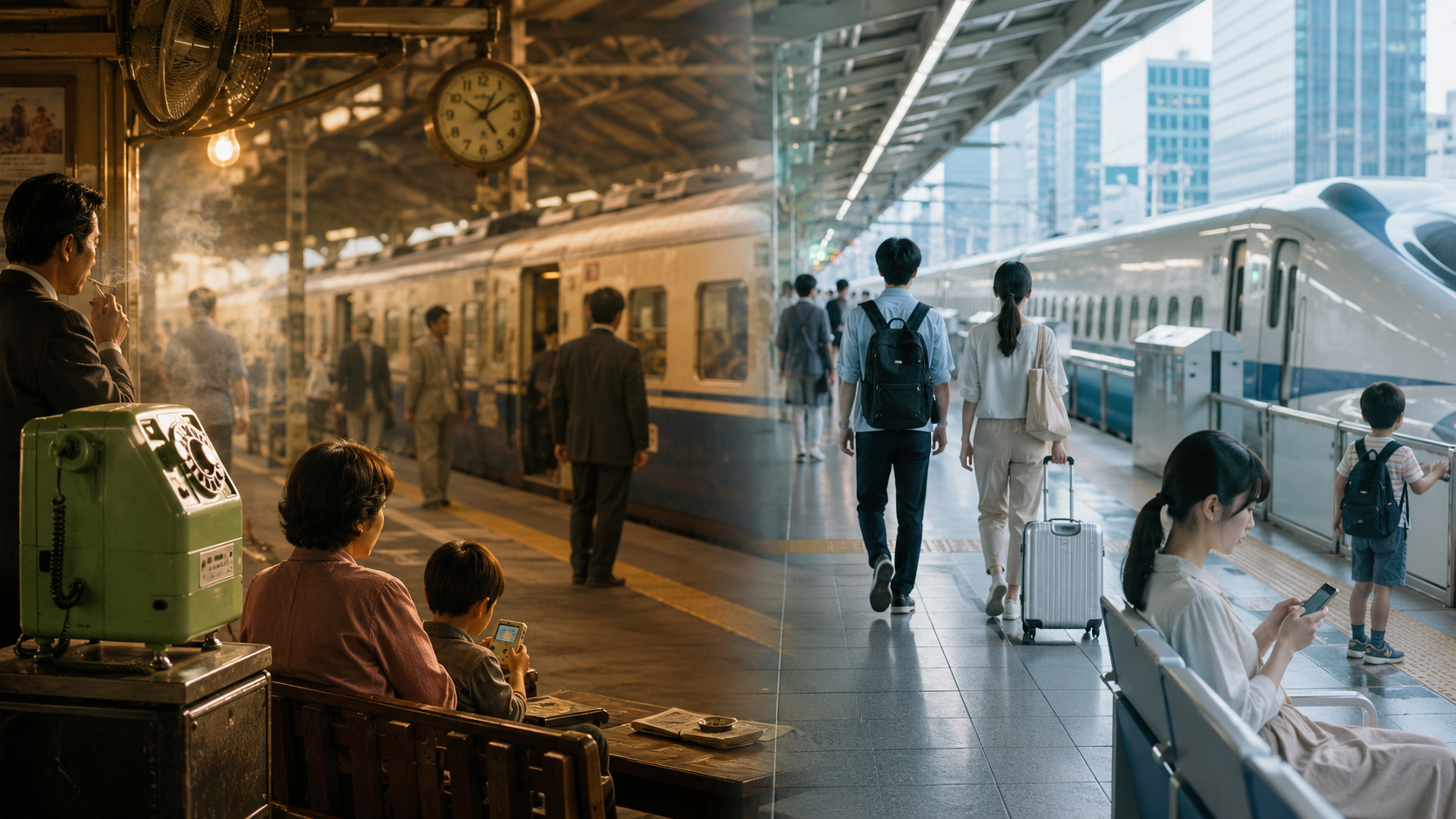
During the Showa and early Heisei eras, people smoked on trains and airplanes, children traveled surprisingly far without mobile phones, seat belts were sometimes treated as optional, and television programs were far less restrained than they are now.
For Japanese people who lived through those years, these scenes may feel nostalgic. For younger generations—and especially for readers outside Japan—they may sound almost impossible.
Here are five everyday things that were once considered surprisingly normal in Japan, along with the social changes that eventually turned them into history.
- Before We Begin: What Are Showa, Heisei, and Reiwa?
- 1. People Could Smoke on Trains and Airplanes
- 2. Physical Punishment Was More Visible at School
- 3. Many People Did Not Wear Seat Belts
- 4. Japanese Television Was Much Less Restrained
- 5. Children Traveled Surprisingly Far on Their Own
- Japan Trivia: Public Phones Were Once Essential
- What Changed Japan?
- Yesterday’s Common Sense Becomes Tomorrow’s Trivia
- Next Episode|Everyday Japanese Manners That May Surprise You
- Final Thoughts
Before We Begin: What Are Showa, Heisei, and Reiwa?
Japan uses both the Western calendar and an era-name system connected to the reign of the emperor. You will often see these era names on official forms, calendars, coins, and public documents.
- Showa era: 1926–1989
- Heisei era: 1989–2019
- Reiwa era: 2019–present
When Japanese people talk nostalgically about “Showa Japan,” they are often referring to the postwar decades from the 1950s through the 1980s. This was a period of rapid economic growth, expanding consumer culture, crowded cities, and dramatic changes in transportation and family life.
The early Heisei years of the 1990s also feel very different from modern Japan. Mobile phones were not yet universal, social media did not exist, and many attitudes toward health, privacy, education, and personal safety had not developed into today’s standards.
With that background in mind, let us travel back to an everyday Japan that has largely disappeared.
1. People Could Smoke on Trains and Airplanes
Modern Japan has extensive smoking restrictions, and smoking is prohibited throughout most public transportation. Yet for many years, lighting a cigarette while traveling was not especially unusual.
Japanese Shinkansen bullet trains once had designated smoking cars. Passengers could sit in their seats, open an ashtray built into the armrest, and smoke during the journey. Even after smoking was removed from ordinary seating areas, enclosed smoking rooms remained on some trains before being phased out.
Commercial airplanes also once separated passengers into smoking and non-smoking sections. From a modern perspective, that may sound ineffective because smoke does not remain politely inside one section of a cabin. At the time, however, smoking was much more deeply woven into social and working life.
Cigarettes could be found almost everywhere:
- office desks and meeting rooms
- restaurants and coffee shops
- train platforms and station waiting rooms
- hotel rooms
- taxis and private cars
- television dramas and advertisements
Offering someone a cigarette could even function as a small social gesture. Ashtrays were standard equipment in many homes, offices, cars, and public facilities.
The change did not occur overnight. Growing awareness of secondhand smoke, changing ideas about public health, and new regulations gradually made smoke-free spaces the norm.
Today, seeing someone smoke in a Shinkansen seat would cause immediate alarm. A few decades ago, another passenger might barely have looked up.
The surprising lesson is that Japan’s famous smoke-free trains are not an ancient tradition. They are a relatively modern social achievement.
2. Physical Punishment Was More Visible at School
Stories about school life in Showa Japan often include extremely strict teachers, powerful sports coaches, and punishments that would be unacceptable today.
Experiences differed greatly between schools, teachers, regions, and generations. Nevertheless, many Japanese adults remember students being struck, forced to stand for long periods, made to kneel in the traditional seiza position, or subjected to exhausting physical exercises as punishment.
Several cultural attitudes helped such practices continue:
- teachers and senior students were expected to command respect
- endurance was often treated as a sign of character
- strict discipline was associated with personal growth
- children were less likely to challenge authority openly
- parents sometimes expected teachers to be severe
This does not mean that every Japanese school used physical punishment or that everyone accepted it. Nor does it mean that corporal punishment was legally encouraged. Japan’s Ministry of Education states that corporal punishment is prohibited under the School Education Act and is unacceptable.
What changed most visibly was society’s willingness to question harmful behavior that had sometimes been excused as “discipline.” Greater attention to children’s rights, psychological well-being, sports safety, and institutional accountability transformed public expectations.
The internet also changed the balance of power. An incident that might once have remained inside a school can now be recorded, reported, and discussed nationwide within hours.
Looking back at old school practices reveals an important point: a behavior can be socially tolerated even when it is neither harmless nor universally supported.
For the current official position, readers can refer to the Japanese Ministry of Education’s policy information.
3. Many People Did Not Wear Seat Belts
In present-day Japan, fastening a seat belt is an automatic part of getting into a car. Children are expected to use appropriate child seats, and modern vehicles include warning sounds, airbags, and other safety systems.
Older memories and photographs tell a different story.
In previous decades, especially in the rear seats, many passengers paid little attention to seat belts. Children might move around the back of the car, kneel on a seat to look through the rear window, or even sleep across the seating area during a long journey.
Families sometimes squeezed more people into a car than would seem reasonable today. A child sitting on an adult’s lap was not always regarded as unusual.
Part of this difference came from vehicle design. Older cars had fewer safety features, and rear-seat belts were not always as visible or convenient as modern ones. More importantly, public understanding of collision risks was less developed.
Safety expectations strengthened gradually through legislation, enforcement, education, and advances in automotive engineering. Japanese drivers also became more conscious of the fact that rear-seat passengers can be seriously injured—or injure people in the front—during a collision.
The transformation extends beyond seat belts. Modern Japanese road safety includes:
- child-restraint systems
- airbags and impact-absorbing vehicle structures
- anti-lock braking systems
- collision-warning and automatic-braking technology
- stronger campaigns against drunk driving
An old family photograph can therefore reveal more than the design of a classic Japanese car. It can show how dramatically the meaning of “safe enough” has changed.
4. Japanese Television Was Much Less Restrained
Japanese television in the Showa era and the early years of Heisei could be loud, unpredictable, and remarkably daring.
Popular variety programs featured elaborate pranks, physically demanding games, embarrassing surprises, and stunts that would now face intense safety reviews. Performers were sometimes placed in situations that modern viewers might consider dangerous, humiliating, or unnecessarily invasive.
Comedy also operated under different expectations. Jokes about appearance, gender, age, social status, and physical discomfort appeared much more freely on mainstream television.
This does not mean that broadcasting had no standards. Japanese television networks had rules, sponsors had influence, and viewers still complained. The major difference was the speed and scale of the public response.
Before social media, most reactions remained relatively private. Viewers might discuss a program at school or work, write a letter, or telephone the broadcaster. A controversial scene was less likely to be clipped, reposted, translated, and judged by millions of people within the same day.
Modern broadcasters must anticipate several concerns:
- physical safety
- privacy and informed consent
- bullying and harassment
- discrimination and human rights
- the influence of programs on children
- instant criticism through social media
Some viewers remember older television as more exciting and spontaneous. Others feel that modern standards were badly needed. Both reactions can be understandable.
The larger story is not simply that “television used to be better” or “old television was terrible.” It is that the relationship between entertainment, audiences, and accountability has fundamentally changed.
5. Children Traveled Surprisingly Far on Their Own
Visitors to Japan are sometimes surprised to see young children walking to school without a parent. This degree of independence still exists in many communities, but childhood during the Showa and early Heisei eras could involve even greater freedom.
After school, children might leave their bags at home, get on their bicycles, and disappear with friends until sunset. Their destinations could include rivers, mountains, empty lots, parks, shopping streets, or neighborhoods several kilometers away.
Some children used local trains or buses without an accompanying adult. There were no smartphones, family-tracking apps, or instant messages. A common instruction from parents was simply:
“Be home before it gets dark.”
This freedom was influenced by several factors. Neighborhood shops, local residents, crossing guards, and other adults formed an informal network of supervision. Children often traveled in groups, and daily routines were shared throughout the community.
However, we should be careful not to romanticize the past. Accidents, crime, bullying, and dangerous play also existed. Families did not necessarily possess better information; in many cases, they simply had fewer ways to remain in constant contact.
Modern parents have access to GPS devices and smartphones, but they also receive immediate news about accidents and crime from across the country. Technology has increased both the ability to monitor children and awareness of possible risks.
Old-fashioned childhood freedom therefore reflected trust, community ties, limited technology, and a different perception of danger—not proof that the past was completely safe.
Children and parents alike had to manage uncertainty in ways that can be difficult to imagine today.
Japan Trivia: Public Phones Were Once Essential
Before mobile phones became common, a green public telephone was one of the most important pieces of communication infrastructure in Japan.
Public phones could be found at railway stations, schools, convenience stores, shopping streets, hospitals, and along busy roads. Many people carried coins or a prepaid telephone card so that they could call home while they were out.
If you were late for a meeting, you searched for a public phone. If you needed someone to collect you from a station, you called their home telephone. If nobody answered, there was often no quick alternative—you simply waited or tried again later.
Because phones did not store personal contacts for you, remembering telephone numbers was a practical life skill. Children frequently memorized their home number, their grandparents’ number, and sometimes the numbers of close friends.
Today, many people cannot recite even the numbers of their closest family members because every contact is stored on a smartphone.
Although public phones are far less prominent now, they have not completely lost their value. Japan continues to recognize them as a means of communication during disasters and other emergencies. NTT East provides information about public phones and their role in maintaining access to essential communication.
You can learn more through NTT East’s official public telephone information.
What Changed Japan?
These five examples may look unrelated, but they share a common pattern. Japanese society gradually placed greater importance on health, safety, individual rights, and accountability.
The transformation was driven by a combination of:
- new laws and safety regulations
- medical research and public-health campaigns
- improvements in transportation and vehicle design
- changing attitudes toward children and education
- the spread of mobile phones and the internet
- greater public scrutiny through social media
Japan is sometimes described overseas as a country where traditions never change. In reality, everyday Japanese life can change surprisingly quickly.
Public smoking, school discipline, family travel, entertainment, and communication were all reshaped within a few generations. What appears to be a timeless Japanese custom may actually be a recent habit—and what once appeared permanent may quietly disappear.
Yesterday’s Common Sense Becomes Tomorrow’s Trivia
For people who remember Showa or early Heisei Japan, these scenes may bring back strong memories: the smell of cigarette smoke on a train, coins prepared for a telephone call, a teacher everyone feared, or a bicycle adventure that parents never fully knew about.
For younger Japanese readers, they can feel like stories from another country. For international readers, they reveal a side of Japan that polished travel advertisements rarely show.
Our own era will eventually receive the same treatment. People in the future may be astonished that we carried smartphones everywhere, drove cars ourselves, used physical cash, or spent hours looking at small screens.
Common sense is never permanent. It is simply a set of habits that a particular society accepts at a particular moment.
Next Episode|Everyday Japanese Manners That May Surprise You
In Discover Japan – Trivia & Culture Series Vol.2, we will explore ordinary Japanese manners that can seem mysterious to visitors.
- Why do Japanese people bow?
- Why must towels stay out of an onsen bath?
- Why are shoes removed at the entrance?
- What does itadakimasu really mean?
- Why do people traditionally stand on one side of an escalator?
These small daily actions contain traces of Japanese history, religion, hygiene, social cooperation, and regional culture.
Final Thoughts
Old Japan was not simply better or worse than Japan today. It operated according to different technology, different risks, and different social expectations.
People could smoke while traveling. School discipline could be severe. Seat belts were sometimes ignored. Television took risks that broadcasters would hesitate to take today. Children moved through their communities without being connected to their parents every minute.
Looking at these differences helps us understand something important: culture is not a fixed museum exhibit. It changes whenever people reconsider what is healthy, safe, respectful, or convenient.
That is why discovering the Japan hidden in everyday life can be so fascinating. Even the most ordinary habit can contain a piece of history.
Discover more stories about Japanese culture and everyday life.
If you are interested in Japanese products and useful items selected from everyday life, you can also visit R2-TM’s Rakuten ROOM collection.
This article is based on information available at the time of writing. Everyday customs and personal experiences differed by region, generation, school, household, and individual circumstances. Historical practices described here should not be interpreted as universal across Japan.
This article may contain promotional links.