5 Japanese Manners That May Surprise Visitors
Hello, I’m R2-TM.
Welcome to Discover Japan – Trivia & Culture Series Vol.2, where we explore the Japan hidden in everyday life.
Why do Japanese people bow instead of shaking hands? Why are shoes removed at the entrance? And why should a small towel never be placed in an onsen bath?
To people in Japan, these customs may feel completely ordinary. For international visitors, however, they can raise many questions.
Japanese manners are sometimes described as a long list of strict rules. In reality, most of them share a simple idea: avoid causing discomfort to others and respect the space you are sharing.
In this article, we will explore five everyday Japanese manners, their cultural background, and what visitors actually need to know.
- 1. Why Do Japanese People Bow?
- 2. Why Must Towels Stay Out of an Onsen Bath?
- 3. Why Are Shoes Removed at the Entrance?
- 4. What Does Itadakimasu Really Mean?
- 5. Why Do People Stand on One Side of an Escalator?
- The Shared Idea Behind Japanese Manners
- A Quick Etiquette Guide for Visitors
- Frequently Asked Questions
- Next Episode|More of the Japan Hidden in Everyday Life
- Final Thoughts
1. Why Do Japanese People Bow?
Bowing is one of the most recognizable forms of Japanese etiquette.
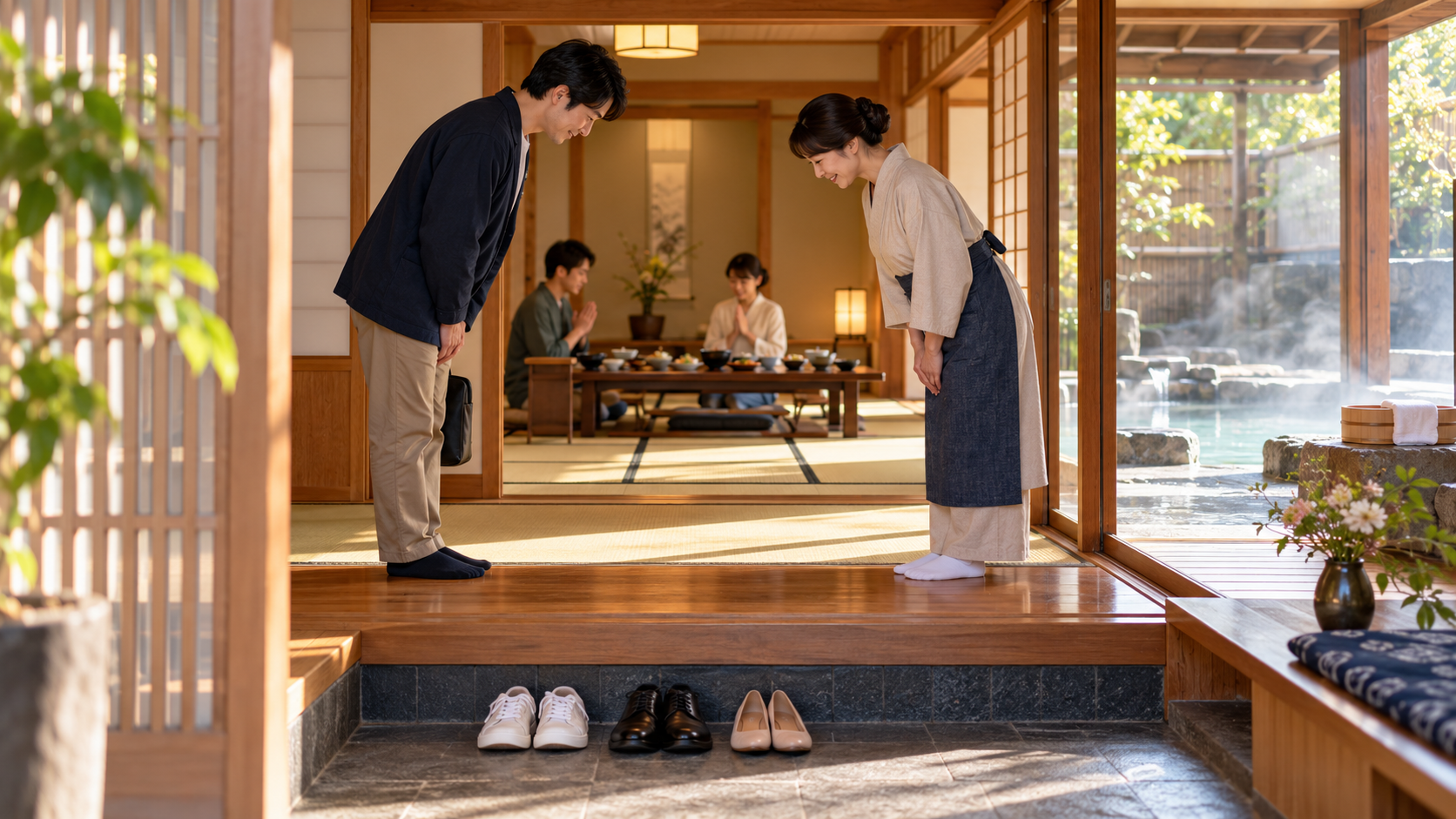
In many countries, people greet one another with a handshake, hug, or kiss on the cheek. In Japan, a small bow can perform the same role without physical contact.
Japanese people bow in many different situations:
- when greeting someone
- when saying goodbye
- when expressing thanks
- when apologizing
- when welcoming a customer
- when showing respect
Not every bow carries the same meaning. A quick nod between friends is very different from the deep, sustained bow used in a serious apology.
In business etiquette, bowing is sometimes explained through precise angles. A light bow may be around 15 degrees, a standard respectful bow around 30 degrees, and a deeper bow around 45 degrees.
These measurements can be useful for training, but ordinary Japanese people do not calculate the angle every time they move. The depth and duration change naturally depending on the situation.
The important point is not geometry. It is the attitude being communicated.
Because bowing does not require touching, it also allows people to acknowledge one another while maintaining personal space. This became especially noticeable during periods when people were more cautious about physical contact.
Should visitors bow in Japan?
Visitors are not expected to master formal Japanese bowing. A small, natural bow of the head is usually enough when greeting someone or expressing thanks.
Trying to bow too deeply in an ordinary situation may feel more theatrical than respectful. A relaxed smile, a slight bow, and a sincere arigato gozaimasu will work well in most situations.
In Japan, the sincerity behind the gesture matters more than achieving a perfect angle.
2. Why Must Towels Stay Out of an Onsen Bath?
Japanese hot springs, known as onsen, offer one of the country’s most memorable cultural experiences. They also have customs that may be unfamiliar to first-time visitors.
One of the best-known rules is simple:
Do not put your towel into the shared bathwater.
At most onsen, bathers carry a small towel into the bathing area. It can be used for washing or for modest coverage while walking, but it should remain outside the bath once you enter the water.
You may place it beside the bath or fold it and rest it on your head, as experienced bathers sometimes do.
The reason is mainly hygiene. A used towel may contain soap, sweat, or other residue. The large bath is shared by everyone, so keeping towels and hair out of the water helps maintain its cleanliness.
This is also why guests wash and rinse their bodies before entering the bath. The tub is intended for soaking and relaxing, not for washing.
Basic onsen etiquette
- Remove all clothing in the changing room unless the facility states otherwise.
- Wash and rinse your body before entering the bath.
- Enter the water slowly and quietly.
- Keep your small towel and hair out of the bathwater.
- Avoid swimming, splashing, or speaking loudly.
- Check the facility’s rules regarding tattoos, children, and photography.
Rules can vary between facilities. Some onsen accept tattoos, some provide covers for small tattoos, and others may restrict entry. Private baths can be a useful alternative when available.
Visitors do not need to feel nervous. If you wash first, keep your towel out of the water, and observe the people around you, you will already understand the essentials.
For further guidance, see the Japan National Tourism Organization’s official onsen guide.
3. Why Are Shoes Removed at the Entrance?
Removing shoes before entering a Japanese home is more than a rule about keeping floors clean. It reflects the traditional division between outside and inside space.
Many Japanese homes have an entrance area called a genkan. The lower floor is where outdoor shoes are removed. The raised interior floor marks the beginning of the clean indoor area.
Stepping onto that raised floor while still wearing outdoor shoes is considered a significant mistake.
After removing their shoes, people commonly turn them so that the toes face the door. This keeps the entrance organized and makes the shoes easier to put on when leaving.
The custom is especially important in rooms with tatami mats. Tatami surfaces are used for sitting, relaxing, and sometimes sleeping, so bringing outdoor dirt onto them would be unpleasant and unhygienic.
Shoes may also need to be removed in:
- traditional restaurants
- ryokan inns
- temples and historic buildings
- some clinics and schools
- fitting rooms
- certain private offices
Watch for toilet slippers
Some Japanese homes, restaurants, and inns provide special slippers for the toilet.
These slippers belong only in that area. Forgetting to remove them and walking back into the living space is a common and slightly embarrassing mistake—even for Japanese people.
If you are unsure whether to remove your shoes, look for a raised floor, shoe rack, slippers, or shoes already arranged near the entrance. You can also ask, “Kutsu wa nuida ho ga ii desu ka?”, meaning, “Should I take off my shoes?”
The official Japan travel guide also explains that removing shoes is expected in most Japanese homes and in many traditional establishments.
The genkan is not merely an entrance. It is a boundary between the outside world and the private interior.
4. What Does Itadakimasu Really Mean?
Before eating, many Japanese people bring their hands together and say:
Itadakimasu.
It is sometimes translated as “Let’s eat” or “Bon appétit,” but neither translation fully captures its meaning.
The verb itadaku is a humble expression meaning “to receive.” In the context of a meal, itadakimasu expresses an awareness that the food has been received through the lives, ingredients, labor, and effort involved in producing it.
That gratitude may extend to:
- the plants and animals that became food
- farmers and fishers
- people who transported and sold the ingredients
- the person who prepared the meal
- everyone sharing the table
It is not necessarily a religious prayer, and people interpret it in different ways. For many families, it is simply an everyday habit learned during childhood.
After finishing the meal, people often say gochisosama deshita. This thanks the person who prepared or provided the food and acknowledges the effort behind the meal.
Do visitors have to say it?
No. International visitors are not required to say itadakimasu before every meal.
However, saying it when eating with a Japanese family or participating in a shared meal is usually appreciated. It shows that you recognize the custom.
At a restaurant, it is also perfectly natural to thank the staff with gochisosama deshita when leaving, particularly at a small establishment where the staff can hear you.
This small phrase reveals something important about Japanese food culture: a meal is viewed not only as something consumed, but also as something received.
5. Why Do People Stand on One Side of an Escalator?
At busy Japanese railway stations, you may see people standing in a neat line on one side of an escalator while leaving the other side open for people in a hurry.
However, there is an important complication:
The side people traditionally leave open is not the same everywhere in Japan.
In Tokyo and many other regions, people have commonly stood on the left and left the right side open. In Osaka and parts of the Kansai region, the opposite pattern became familiar: stand on the right and leave the left side open.
There are several explanations for how these regional habits developed, including the influence of railway campaigns and major international events. The complete history is more complicated than one simple origin story.
Is leaving one side open still the recommended rule?
No—not officially.
Although the habit remains visible, Japan’s current safety guidance encourages passengers to stand still and hold the handrail instead of walking on escalators.
Walking can lead to collisions, falls, and difficulties for people who need to hold a particular handrail because of age, injury, disability, or balance limitations.
The Ministry of Land, Infrastructure, Transport and Tourism promotes a “Stand on Both Sides” approach. Some local governments and railway operators also run campaigns asking passengers not to walk.
Therefore, visitors should not worry about memorizing “left in Tokyo, right in Osaka” as if it were a permanent national rule.
The safer modern practice is:
- step onto the escalator carefully
- stand still rather than walk
- hold the handrail when possible
- do not block tactile paving with luggage
- follow local signs and staff instructions
You can read more in the Government of Japan’s guidance on elevator and escalator safety.
This is an excellent example of how etiquette changes. What was once treated as considerate behavior—leaving space for people to walk—is now being reconsidered because safety and accessibility have become more important.
The Shared Idea Behind Japanese Manners
Bowing, removing shoes, keeping towels out of an onsen, expressing gratitude before eating, and standing safely on an escalator may appear unrelated.
Yet they are connected by one broad principle:
Think about how your actions affect a space shared with other people.
Japanese society often places value on avoiding meiwaku—trouble, inconvenience, or discomfort caused to others.
This does not mean that every Japanese person follows every rule perfectly. Nor does it mean that Japan has one universal code of behavior. Customs change depending on region, generation, setting, and individual preference.
Japanese etiquette is also evolving. Escalator behavior is changing. Tattoo policies at onsen are becoming more varied. Handshakes are common in international business, and many households have their own routines.
Manners should therefore be understood as living social habits, not as unchanging ancient laws.
A Quick Etiquette Guide for Visitors
| Situation | What to Do | Common Mistake |
|---|---|---|
| Greeting someone | Use a small, natural bow | Bowing too deeply in a casual situation |
| Entering a home | Remove shoes at the genkan | Stepping onto the raised floor in outdoor shoes |
| Entering an onsen | Wash first and keep the towel out of the water | Using the shared bath for washing |
| Starting a meal | Say itadakimasu if appropriate | Thinking it has only one direct English translation |
| Using an escalator | Stand still and follow local guidance | Assuming walking on the open side is officially recommended |
Visitors are rarely expected to know every custom in advance. Paying attention, following posted instructions, and showing consideration matter far more than perfection.
Frequently Asked Questions
Will Japanese people be offended if I forget to bow?
Usually not. International visitors are not expected to understand every detail of Japanese etiquette. A polite greeting and respectful attitude are enough in most everyday situations.
Do I have to remove my shoes in every Japanese building?
No. Shoes remain on in most shops, stations, offices, and Western-style restaurants. Remove them when there is a genkan, raised floor, tatami room, shoe rack, slippers, or a clear request to do so.
Can I wear a swimsuit in an onsen?
Most traditional shared onsen do not allow swimsuits, but rules vary. Some mixed-gender baths, outdoor facilities, and modern spa-style establishments require or permit special bathing wear. Always check the facility’s instructions.
Should I leave one side open on a Japanese escalator?
Although many commuters still follow regional habits, current safety guidance encourages passengers to stand rather than walk. Follow station signs and avoid pressuring other people to move aside.
Next Episode|More of the Japan Hidden in Everyday Life
The next volume of Discover Japan – Trivia & Culture Series will explore another side of Japanese life that may look ordinary at first but contains a surprising cultural story.
The Vol.3 title and link will be added after the corresponding Japanese article and publication URL are confirmed.
Final Thoughts
Japanese manners can seem complicated when presented as a list of rules. Once we understand the ideas behind them, they become much easier to remember.
- A bow acknowledges another person without requiring physical contact.
- Removing shoes protects the cleanliness of the interior.
- Keeping towels out of an onsen respects a shared bath.
- Itadakimasu expresses gratitude for receiving a meal.
- Modern escalator guidance prioritizes safety and accessibility.
None of these customs should be treated as proof that all Japanese people behave in exactly the same way. Japan contains regional differences, generational changes, and personal variations just like any other country.
The best approach is not to become anxious about making a mistake. Observe the space, follow local guidance, and consider the people around you.
That spirit of consideration is more important than memorizing every rule.
Explore more stories from Discover Japan.
If you are interested in useful items selected from everyday life in Japan, visit R2-TM’s Rakuten ROOM collection.
This article is based on information available at the time of writing. Manners and facility rules may differ according to region, generation, household, establishment, and individual circumstances. When visiting a facility, always follow its current posted rules and staff instructions.
This article may contain promotional links.