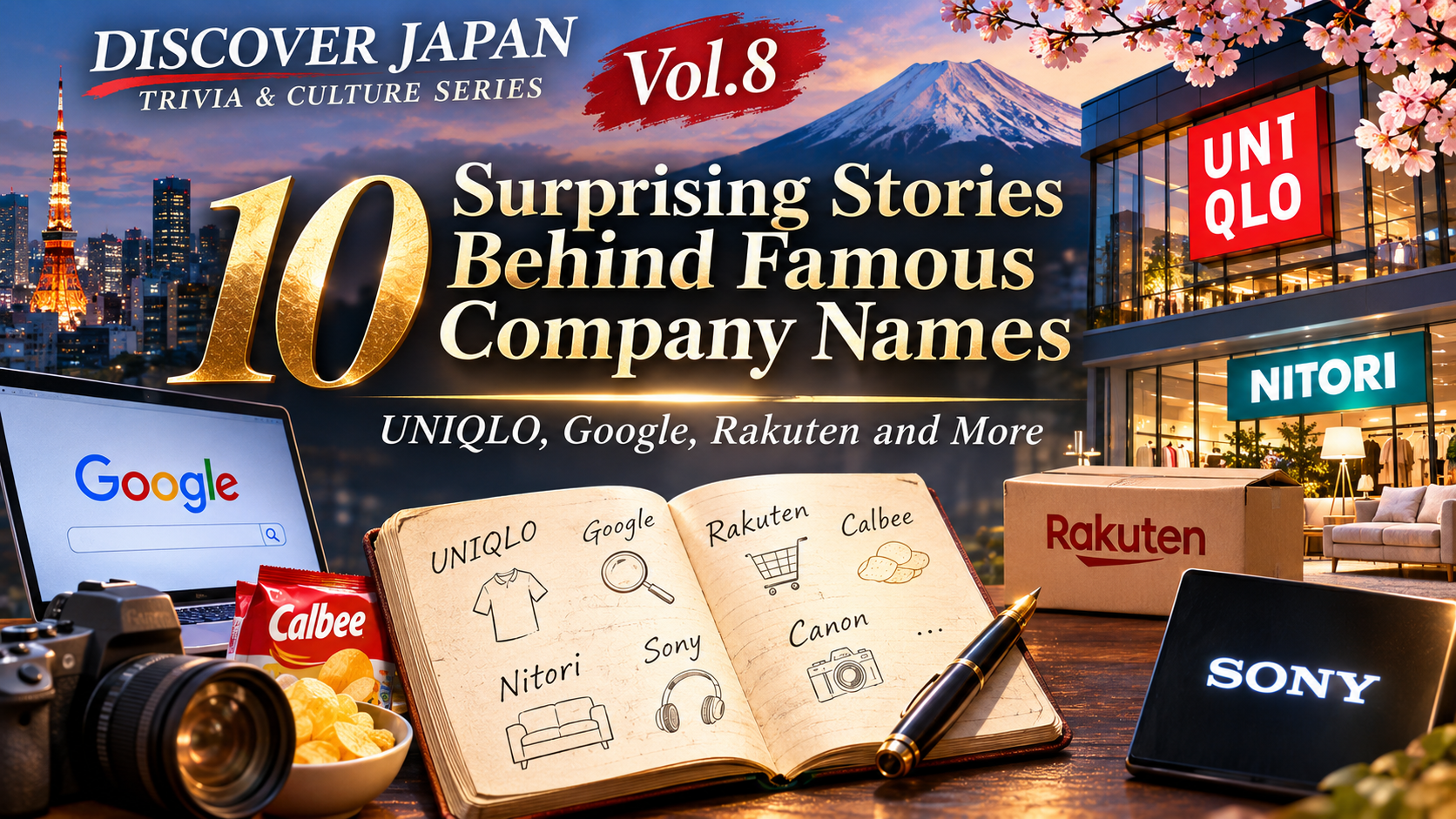
10 Surprising Company Name Origins: The Stories Behind Famous Brands
Discover Japan – Trivia & Culture Series | Vol.8
Discover the Japan Hidden in Everyday Life.
Hello, I’m R2-TM.
Imagine walking through a shopping district in Tokyo. You pass a UNIQLO store, spot a Canon camera in a shop window, and notice a Toyota driving down the street. Later, you search Google for a restaurant and browse Rakuten for something to buy.
Every one of those familiar names has a story.
Some were carefully chosen to express a company’s ambitions. Others came from family names, ancient traditions, or unexpected accidents. One even has a connection to a Buddhist figure worshipped in Japan.
Company name origins reveal far more than clever marketing. They offer glimpses into the people, cultures, and historical circumstances that shaped the brands we recognize today.
In this installment of Discover Japan – Trivia & Culture Series, we’ll explore ten famous names from Japan and around the world.
Along the way, we’ll discover why UNIQLO contains an unexpected Q, how Google’s name connects to an enormous number, and why Toyota changed a single sound in its founder’s family name.
Let’s begin with a spelling mistake that became part of a global fashion brand.
- 1. UNIQLO: The Accidental Q That Became Famous
- 2. Google: A Search Engine Named After an Enormous Number
- 3. Rakuten: A Japanese Online Marketplace Inspired by Sixteenth-Century History
- 4. Calbee: The Snack Brand Named After Two Nutrients
- 5. Nitori: A Family Name That Became a Furniture Empire
- 6. Sony: A Japanese Name Built from Latin and English
- 7. Canon: The Camera Brand with a Buddhist Connection
- 8. IKEA: Four Letters That Preserve a Founder’s Home
- 9. Toyota: Why the Name Changed from Toyoda
- 10. adidas: The Founder’s Nickname That Nearly Had a Different Spelling
- Six Ways Famous Company Names Are Created
- Five More Interesting Facts About Brand Names
- Why Brand Name Origins Are Worth Exploring
- Conclusion: Every Famous Name Has a Beginning
- Continue Exploring Japanese Culture and Everyday Discoveries
- Official Sources and Further Reading
- Next Episode
1. UNIQLO: The Accidental Q That Became Famous
Take a look at the word UNIQLO.
It feels familiar now, especially if you’ve ever shopped for the Japanese brand’s everyday clothing. But there’s something unusual about its spelling.
Why does it contain a Q?
The story begins with the original name behind the brand: Unique Clothing Warehouse.
The idea was to create a store where customers could freely browse and select casual clothing without feeling pressured by sales staff.
Rather than presenting clothing as something available only through formal department-store service, the concept emphasized accessibility and personal choice.
The lengthy original name was shortened to UNICLO.
Then came the unexpected twist.
How a registration mistake changed the brand
According to UNIQLO’s official explanation, during the registration of an overseas company, the local person handling the paperwork mistakenly wrote UNIQLO instead of UNICLO.
The company could have corrected the spelling.
Instead, the management decided that the Q looked more attractive as part of the brand’s visual identity.
The spelling was adopted.
A mistake had become a design choice.
Today, the distinctive combination of letters is recognized internationally. Yet its unusual appearance wasn’t the result of an elaborate marketing formula.
It was an accident that the company chose to keep.
UNIQLO’s surprising Hiroshima connection
There’s another detail worth knowing.
The first UNIQLO store opened in Hiroshima, Japan, in 1984.
Hiroshima is internationally known for its history and its message of peace. It is also a city with important connections to Japanese business and manufacturing.
UNIQLO’s story illustrates how a company can grow from a regional retail business into an international brand while retaining traces of its humble beginnings.
The next time you see the familiar UNIQLO sign, notice the Q.
Sometimes a brand’s most recognizable feature begins with something nobody planned.
Source: UNIQLO – Official explanation of the brand name (Japanese).
2. Google: A Search Engine Named After an Enormous Number
What would the internet look like if people still said, “I’ll Backrub that”?
Strange as it sounds, Backrub was the original name of the search engine that eventually became Google.
The story begins at Stanford University in 1995.
Larry Page and Sergey Brin were exploring ways to organize information on the rapidly growing World Wide Web.
Their search technology examined links between web pages to help determine the importance of different sources.
Backrub reflected this link-based approach, but the name didn’t last.
From Backrub to googol
The name Google was inspired by the mathematical term googol.
A googol is the number 1 followed by 100 zeros.
Written mathematically, it is 10 to the power of 100.
That’s an extraordinarily large number, far beyond anything most of us encounter in everyday calculations.
Why choose it for a search engine?
According to Google’s official company history, the name reflected the founders’ ambition to organize an enormous quantity of information and make it accessible and useful.
The meaning was bigger than a search box.
It expressed the scale of the problem the company wanted to solve.
Why the name still fits
When you type a question into Google today, you rarely think about the mathematics behind its name.
But consider how many subjects people search for: weather forecasts, university research, recipes, travel directions, historical records, and almost anything else that can be expressed as a question.
The company name points toward that vast world of information.
And it began with a mathematical expression that most people had never heard of.
Source: Google – Our Story.
3. Rakuten: A Japanese Online Marketplace Inspired by Sixteenth-Century History
Rakuten is a name many online shoppers recognize, particularly in Japan.
Its history contains a fascinating link between modern e-commerce and the marketplace reforms of Japan’s feudal era.
To understand the connection, we need to travel back several centuries.
What was Rakuichi-Rakuza?
During Japan’s Sengoku period, often called the Warring States period, powerful regional leaders competed for political and economic control.
One approach to strengthening local commerce was to reduce certain privileges and restrictions that controlled how merchants could trade.
These measures became associated with the term rakuichi-rakuza.
The concept is commonly connected with Oda Nobunaga, one of the major figures in Japan’s sixteenth-century history.
Although the actual historical policies varied by region and period, their broad association with freer commercial activity became an important part of Japanese historical memory.
Centuries later, that image helped inspire the name Rakuten Ichiba.
Bringing an old marketplace idea onto the internet
Rakuten Ichiba was launched in 1997 as an online shopping marketplace.
The company explains that its name drew inspiration from rakuichi-rakuza and the aspiration to create an open, lively place for trade on the internet.
The Japanese word rakuten also carries associations with optimism.
Together, these ideas provided a name that suggested both commercial opportunity and a positive outlook.
Rather than imagining the internet only as a collection of individual stores, the founders envisioned a marketplace where many merchants and customers could meet.
Today, the Rakuten name appears across a variety of services, from online shopping to financial and digital businesses.
But its origins lead back to the idea of a marketplace—and ultimately to a chapter of Japanese history.
For international readers, that’s an intriguing example of how older cultural concepts can influence the language of modern technology.
Source: Rakuten Group – One Brand Concept.
4. Calbee: The Snack Brand Named After Two Nutrients
If you’ve visited a Japanese supermarket, you’ve probably seen shelves filled with colorful snack packages.
One familiar name is Calbee, a company associated with potato chips and other popular snacks.
The name sounds like it might be an invented English word.
And in a sense, it is.
But its original meaning has more to do with nutrition than with snacks.
Calcium plus vitamin B1
Calbee combines two nutritional terms:
- Cal comes from calcium.
- Bee represents vitamin B1.
The company adopted the name to express its ambition to produce foods that could contribute to people’s health.
That may seem surprising if your main association with Calbee is a bag of crispy potato chips.
But a company name can preserve an older ambition, even after its product range changes.
Another company with roots in Hiroshima
Calbee’s corporate history also leads to Hiroshima.
The business was incorporated there in 1949 under the name Matsuo Food Processing Co., Ltd.
In 1955, it changed its name to Calbee Confectionery Co., Ltd.
Its famous shrimp-flavored snack, Kappa Ebisen, appeared in 1964.
This means that both UNIQLO and Calbee, despite operating in completely different industries, have historical roots in Hiroshima.
For visitors exploring Japan beyond Tokyo and Kyoto, such connections provide a reminder that the country’s business history extends well beyond its largest commercial centers.
The next time you open a Calbee snack, remember that its name began with calcium and vitamin B1.
Source: Calbee – Corporate History.
5. Nitori: A Family Name That Became a Furniture Empire
Not every successful brand name begins with complicated wordplay.
Sometimes the explanation is remarkably simple.
Nitori, the Japanese home furnishing retailer, takes its name from its founder, Akio Nitori.
The company began as a furniture business in Hokkaido, Japan’s northernmost main island.
Hokkaido is known for its snowy winters, distinctive landscapes, and a regional culture shaped partly by its climate and geography.
From those beginnings, Nitori grew into a major furniture and home furnishing business.
When the founder’s name becomes the brand
Using a family name as a company name creates a direct connection between the founder and the business.
Customers may not know the individual behind the name, but the identity remains embedded in the brand.
This is different from an invented word that describes a product, a service, or a company philosophy.
It is a more personal form of naming.
For Nitori, the founder’s name has continued to represent the business even as it expanded far beyond its original furniture store.
One detail is worth remembering when reading corporate histories: Nitori, the retail business, and Nitori Holdings, the corporate group, are not identical legal entities.
Brand names and registered company names can overlap without always referring to the same organization.
Source: Nitori Holdings – Company Profile.
6. Sony: A Japanese Name Built from Latin and English
Few Japanese electronics names are as internationally familiar as Sony.
Its products and businesses have appeared in music, entertainment, photography, gaming, and many other fields.
Yet the word Sony is not an ordinary Japanese word.
Its origins combine two different languages.
Sonus and sonny
The first component comes from the Latin word sonus, meaning sound.
The second comes from the English expression sonny, associated with a young boy or youthful spirit.
According to Sony’s official historical materials, the two words were combined to create a short, memorable name.
There was a practical advantage to this decision.
A company seeking international customers benefits from a name that people in different countries can recognize, read, and pronounce.
The founders wanted something distinctive that could travel beyond Japan’s borders.
Sony wasn’t always called Sony
The company’s predecessor was established in 1946 as Tokyo Tsushin Kogyo, often translated as Tokyo Telecommunications Engineering Corporation.
The corporate name was changed to Sony Corporation in 1958.
This change reflected an important stage in the development of the business.
Rather than relying entirely on a longer, technically descriptive Japanese name, the company adopted a compact identity suitable for international markets.
The word’s connection with sound also remained meaningful as Sony developed products related to music and audio.
Today, Sony operates in many areas that extend far beyond sound technology.
Yet the original linguistic idea remains visible every time you see those four letters.
Source: Sony Group – Code of Conduct, company name history.
7. Canon: The Camera Brand with a Buddhist Connection
Imagine a camera prototype created in Japan in the 1930s.
The engineers developing it wanted to produce a high-quality camera that could compete internationally.
But the name they chose for the prototype wasn’t based on optics, photography, or engineering.
It came from Buddhism.
From Kwanon to Canon
In 1934, a predecessor of Canon developed a camera prototype known as Kwanon.
The name referred to Kannon, a figure associated with compassion in East Asian Buddhism.
Kannon is commonly understood in Japan as a compassionate bodhisattva, corresponding to Avalokiteshvara in Buddhist traditions.
The prototype’s name expressed the developers’ hopes for success in creating an outstanding camera.
The original imagery was also connected to the thousand-armed representation of Kannon.
It’s an unexpected connection between traditional religious culture and the history of precision engineering.
Why the brand became Canon
As the developers prepared to move toward commercial production, they needed a name that could work internationally.
In 1935, Canon was registered as a trademark.
The word canon can carry meanings relating to rules, standards, or authoritative texts.
Those associations suited a company seeking precision and technical excellence.
The pronunciation also resembled Kwanon closely enough to provide continuity with the original name.
Over time, Canon became the familiar brand associated with cameras, imaging equipment, and printers.
The Japanese company name is written キヤノン, using a full-sized Japanese character ya rather than the smaller character sometimes expected in phonetic spelling.
Canon explains that this visual choice helped create a more balanced appearance when the name was written in Japanese.
Behind a modern international brand lies a remarkable combination of Buddhist tradition, linguistic adaptation, and industrial ambition.
Source: Canon Global – Origin of the Canon Logo.
8. IKEA: Four Letters That Preserve a Founder’s Home
Now let’s travel from Japan to Sweden.
IKEA is known internationally for affordable home furnishings, flat-pack furniture, and distinctive store layouts.
Its name is only four letters long.
Yet those letters contain the founder’s name and two places connected to his childhood.
What does IKEA stand for?
The letters represent:
- I – Ingvar
- K – Kamprad
- E – Elmtaryd
- A – Agunnaryd
Ingvar Kamprad was the company’s founder.
Elmtaryd was the family farm where he grew up, while Agunnaryd was the nearby village or parish.
In other words, IKEA is a compressed record of a person and his home.
The company was founded in 1943, when Kamprad was just 17 years old.
Its early activities were not limited to furniture. The business initially traded everyday goods, with furniture introduced later.
A global brand with local roots
Many companies choose names designed to suggest scale, technological ambition, or an international future.
IKEA’s name began with something much smaller and more personal.
A young entrepreneur.
A family farm.
A village in Sweden.
Those origins remained part of the name even as the company reached customers in numerous countries.
It’s a useful reminder that global recognition and local identity are not opposites.
Sometimes a company becomes international without abandoning the name of the place where its story began.
Source: IKEA – The Story of IKEA.
9. Toyota: Why the Name Changed from Toyoda
Toyota is one of the most recognizable names in the global automotive industry.
But the founding family’s surname is Toyoda, not Toyota.
That single difference—a D becoming a T—wasn’t accidental.
It reflected a deliberate change in the company’s public identity.
The three reasons behind Toyota’s name
According to Toyota’s official history, several considerations influenced the choice.
First, Toyota was considered smoother and clearer in Japanese pronunciation.
The original name, Toyoda, includes a voiced consonant. Toyota uses an unvoiced consonant, giving it a different sound.
Second, the Japanese katakana spelling トヨタ contains eight strokes when written in the conventional way used for this explanation.
In Japanese culture, the number eight is often considered auspicious.
The shape of the Japanese character for eight, 八, widens toward the bottom, and it has long been associated with the idea of expanding prosperity.
Third, moving away from the founder’s surname symbolized a change from a family-centered enterprise toward a broader corporate identity.
A small spelling change with a larger meaning
For international readers, Toyoda and Toyota may appear to be nearly identical names.
But in Japanese, the distinction has cultural and linguistic significance.
It involves pronunciation, written character counts, and the symbolic meaning of a company stepping beyond its founding family.
The Toyota brand name was adopted during the company’s early automotive development, and Toyota Motor Co., Ltd. was established in 1937.
The change illustrates how even one sound can carry a company’s aspirations.
A brand name isn’t always just a label for products.
Sometimes it represents a decision about what kind of organization a business hopes to become.
Source: Toyota Motor Corporation – Toyota Brand and Emblem.
10. adidas: The Founder’s Nickname That Nearly Had a Different Spelling
Our final story takes us to Germany.
Adidas is one of the best-known names in sports footwear and apparel.
People sometimes assume that the word must be an abbreviation of a motivational phrase.
Its actual origin is much simpler.
It comes from the name of a shoemaker.
Adi Dassler and the creation of adidas
The founder was Adolf Dassler, commonly known as Adi.
The name adidas combines his nickname with part of his surname.
But the story includes another unexpected complication.
According to adidas’s official historical account, the original proposed spelling was Addas.
However, a similar name was already being used by a children’s shoe manufacturer.
The registration was rejected.
Instead of starting from scratch, Dassler added the letter I.
The result was adidas.
Another brand shaped by circumstances
In 1949, Adi Dassler registered his new company in Herzogenaurach, Germany.
His ambition was to develop better athletic footwear and equipment.
That commitment to sport helped shape the company’s development.
The naming story also creates an interesting parallel with UNIQLO.
UNIQLO’s Q came from an unexpected spelling error, while adidas’s final spelling emerged from a registration obstacle.
Neither example followed a perfectly predictable naming plan.
Sometimes the names we recognize most easily are the result of a founder adapting to circumstances.
What could have been an inconvenience becomes part of a brand’s identity.
Source: adidas Group – Adolf Dassler and the Brand’s Early History.
Six Ways Famous Company Names Are Created
Looking across these ten stories reveals several recurring naming patterns.
Some founders wanted names that expressed large ambitions. Others looked to their own identities, the places they came from, or cultural traditions.
And a few names were shaped by mistakes that became unexpectedly useful.
| Naming Approach | Examples | Underlying Idea |
|---|---|---|
| Vision and ambition | Google, Rakuten | A name expressing the world a company hopes to create. |
| Combining words | Calbee, Sony | Different concepts condensed into one memorable word. |
| Founder’s identity | Nitori, adidas | The founder’s name or nickname becomes the brand. |
| Personal geography | IKEA | Names of meaningful places become part of the company identity. |
| Spelling and pronunciation | UNIQLO, Toyota | Visual appeal, language, and symbolism shape the final name. |
| Historical or cultural inspiration | Canon, Rakuten | Traditional ideas are adapted for modern business. |
These categories aren’t always exclusive.
Rakuten’s name, for example, reflects both a business vision and an image borrowed from Japanese history.
Toyota’s spelling change involved pronunciation, visual symbolism, and a corporate ambition.
Names often carry several layers of meaning at once.
Five More Interesting Facts About Brand Names
Extra Fact 1: A Brand Name Isn’t Necessarily a Company’s Legal Name
UNIQLO is a recognizable clothing brand, but the wider corporate group is associated with Fast Retailing.
Similar distinctions exist across many industries.
A company might operate several brands under one corporate structure, while consumers encounter only the names printed on products.
When researching a company’s history, it’s useful to distinguish the consumer-facing brand from the legal organization behind it.
Extra Fact 2: Short Names Can Contain Several Meanings
Sony combines linguistic elements associated with sound and youth.
Calbee draws from calcium and vitamin B1.
Both demonstrate how a compact name can contain an unexpectedly detailed story.
A short name may be easy to remember precisely because its underlying explanation is not immediately obvious.
Extra Fact 3: A Mistake Can Become an Advantage
UNIQLO and adidas illustrate a curious principle of business history.
The final result isn’t always the founder’s first choice.
A registration mistake or a rejected name can lead to a change that becomes part of the company’s identity for decades.
What matters is not only the original plan but also how people respond when the plan changes.
Extra Fact 4: International Expansion Changes the Rules of Naming
A name that sounds natural in one language can be difficult to pronounce in another.
It may also carry unintended associations across cultures.
Sony and Canon offer historical examples of Japanese businesses adopting short, internationally usable names.
For companies seeking customers across borders, a memorable name can help communicate identity without requiring a lengthy explanation.
Extra Fact 5: Names Preserve the Past Even When Companies Change
IKEA continues to reflect a founder and his childhood home.
Calbee’s name preserves a nutritional ambition.
Rakuten carries an image of open marketplaces from Japanese history.
These businesses have changed significantly since their early days.
Yet the names still contain fragments of their origins.
Company names can function like small historical records hiding in plain sight.
Why Brand Name Origins Are Worth Exploring
Most of us encounter company names without thinking about them.
We see them on shopping bags, phone screens, food packages, vehicles, and signs above store entrances.
Over time, those words become so familiar that we stop noticing them.
But the stories behind them are surprisingly human.
Someone had to choose the name.
Perhaps the founder wanted to honor a family name. Perhaps a business was inspired by its hometown. Or perhaps a simple mistake created a spelling that felt better than the original.
Some names reflect an entire historical moment.
Rakuten connects modern internet commerce with ideas associated with sixteenth-century Japan.
Canon preserves a link between early Japanese camera development and Buddhist tradition.
Toyota reflects the importance of sound, character design, and symbolic numbers in Japanese business culture.
These connections make company history feel less distant.
A familiar sign on a city street can become an invitation to explore language, culture, and the decisions of people who lived decades or even centuries before us.
Conclusion: Every Famous Name Has a Beginning
We began with a simple question: why do familiar companies have the names they do?
Ten stories later, the answers have taken us from a clothing store in Hiroshima to a Stanford University search project, from a Swedish family farm to a camera prototype named after a Buddhist figure.
We’ve seen names inspired by numbers, nutrition, family history, regional identity, and Japanese traditions.
We’ve also seen how accidents and practical obstacles sometimes become part of a company’s most recognizable features.
Perhaps the most memorable lesson is that even the biggest brands were once small ideas.
Before a company becomes internationally famous, someone must decide what to call it.
That decision may last much longer than anyone expects.
The next time you’re shopping, browsing the internet, or passing a familiar store sign, take another look at the name.
There may be an entire story waiting behind those few letters.
Continue Exploring Japanese Culture and Everyday Discoveries
This article is part of Discover Japan – Trivia & Culture Series, a collection exploring the surprising history, science, and cultural meaning hidden in ordinary life.
Interested in more unusual discoveries?
Visit the R2-TM Blog for additional articles about everyday curiosities, Japanese life, and practical knowledge.
For the original Japanese-language perspective, you can also explore the blog’s Japanese trivia collection through the main site.
If you enjoy exploring useful products and lifestyle ideas from Japan, you can visit my Rakuten ROOM collection. Please check the latest product specifications, compatibility, prices, and availability before purchasing.
Official Sources and Further Reading
- UNIQLO – Official Brand Name Explanation
- Google – Our Story
- Rakuten Group – Brand Story
- Calbee – Company History
- Nitori Holdings – Company Profile
- Sony Group – Corporate Code of Conduct
- Canon – Origin of the Logo
- IKEA – The Story of IKEA
- Toyota – Toyota Brand and Emblem
- adidas Group – Adolf Dassler and the Origins of adidas
Next Episode
Discover Japan – Trivia & Culture Series | Vol.9
In the next installment, we’ll continue exploring the hidden stories behind familiar aspects of everyday life.
From Japanese customs to overlooked details of modern technology, there’s always something new to discover.
Editorial Disclaimer: This article was prepared using publicly available corporate histories, official company statements, and other sources reviewed at the time of writing. Information may be updated, corrected, or interpreted differently as new materials become available. While reasonable care has been taken to present accurate information, completeness and absolute accuracy cannot be guaranteed. This article is intended for general educational and cultural purposes and is not affiliated with, endorsed by, or sponsored by any of the companies discussed. Company names, logos, and trademarks belong to their respective owners. Readers should consult official sources for the latest information.
Affiliate Disclosure: This article contains promotional or affiliate links. The website may earn a commission from qualifying purchases made through those links, at no additional cost to you.
コメント